



Crypto Markets 2026: A Dynamic Shift Amidst ETF Inflows and Market Fatigue
As the crypto markets ushered in 2026, they found themselves on more stable ground thanks to a resurgence in spot exchange-traded fund (ETF) inflows. This positive momentum comes even as various on-chain indicators indicate underlying weaknesses. Analysts highlighted that Bitcoin spent the end of 2025 in a consolidation phase, teetering just below a key resistance level of $92,000. This period of relative stability, supported by institutional inflows, contrasts starkly with the earlier December trend characterized by sustained ETF outflows that dampened market sentiment.
Timothy Misir, head of research at BRN, remarked on this shifting dynamic, noting that while there is renewed optimism in the market, the existing conviction remains "conditional." This caution stems from the disparity between the external support from ETF inflows and the internal challenges marked by diminishing bullish sentiment. Between December 29 and January 2, spot Bitcoin ETFs experienced net inflows totaling approximately $459 million, contributing to a trading volume close to $14 billion. In parallel, Ether ETFs added $161 million and XRP ETFs attracted $43 million, signifying a revitalized institutional involvement as investors adjusted their strategies for the new year.
Despite the positive ETF inflows, Bitcoin’s price action has remained relatively range-bound. Throughout early January, Bitcoin oscillated between the mid-$87,000s and low-$90,000s, maintaining its position around $93,000. Ether’s performance mirrored this stability, trading near the $3,200 mark. Broader altcoin performance, however, exhibited mixed signals, suggesting a cautious market sentiment rather than a outright risk appetite.
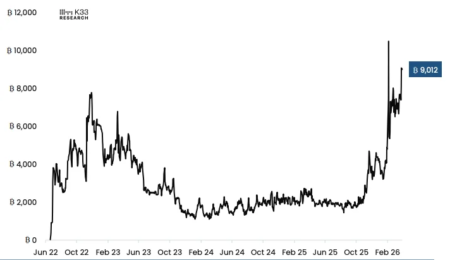
On the flip side, on-chain metrics indicate persistent weaknesses. Bitcoin’s realized capitalization saw a negative shift by late December, marking an end to one of the longest periods of uninterrupted positive inflows in the network’s history. Simultaneously, long-term holders (LTH) began to realize losses at an accelerated rate, despite Bitcoin’s steadiness in price. Misir identified this trend as a classic late-cycle scenario, wherein price compression, fading volatility, and investor fatigue manifest. In such circumstances, exit decisions are driven not by fear but by the exhaustion of buying power.
The current market structure suggests a pivotal transition from a flow-driven phase toward one requiring patience. While ETF inflows may mitigate the risk of deeper market corrections, analysts believe sustained price appreciation necessitates renewed on-chain capital formation. QCP Capital echoed this stance, raising caution about market liquidity conditions remaining delicate even amidst early January strength, which coincided with broader risk assets.
Market behavior also fluctuated recently, highlighted by Bitcoin’s ascent past the $93,000 mark. Traders remained vigilant, especially regarding geopolitical developments related to U.S. operations in Venezuela. Although such headlines have captured attention, they have not significantly altered the near-term macro outlook for risk assets. Analysts predict that forthcoming economic data releases in January will play a critical role in shaping rate expectations and influencing broader market sentiment in the coming weeks.
In conclusion, while crypto markets show signs of a cautious yet positive sentiment moving into 2026, the interplay of ETF inflows and inherent market fatigue presents a complex landscape for investors. As institutional participation surges, the critical challenge will be maintaining momentum through renewed on-chain capital formation. Investors must remain attuned to economic signals and geopolitical developments, as they hold the potential to significantly influence market dynamics in this evolving era of cryptocurrency trading.