




Bitcoin Faces Possible Drop to $60K Amid Deepening Market Weakness
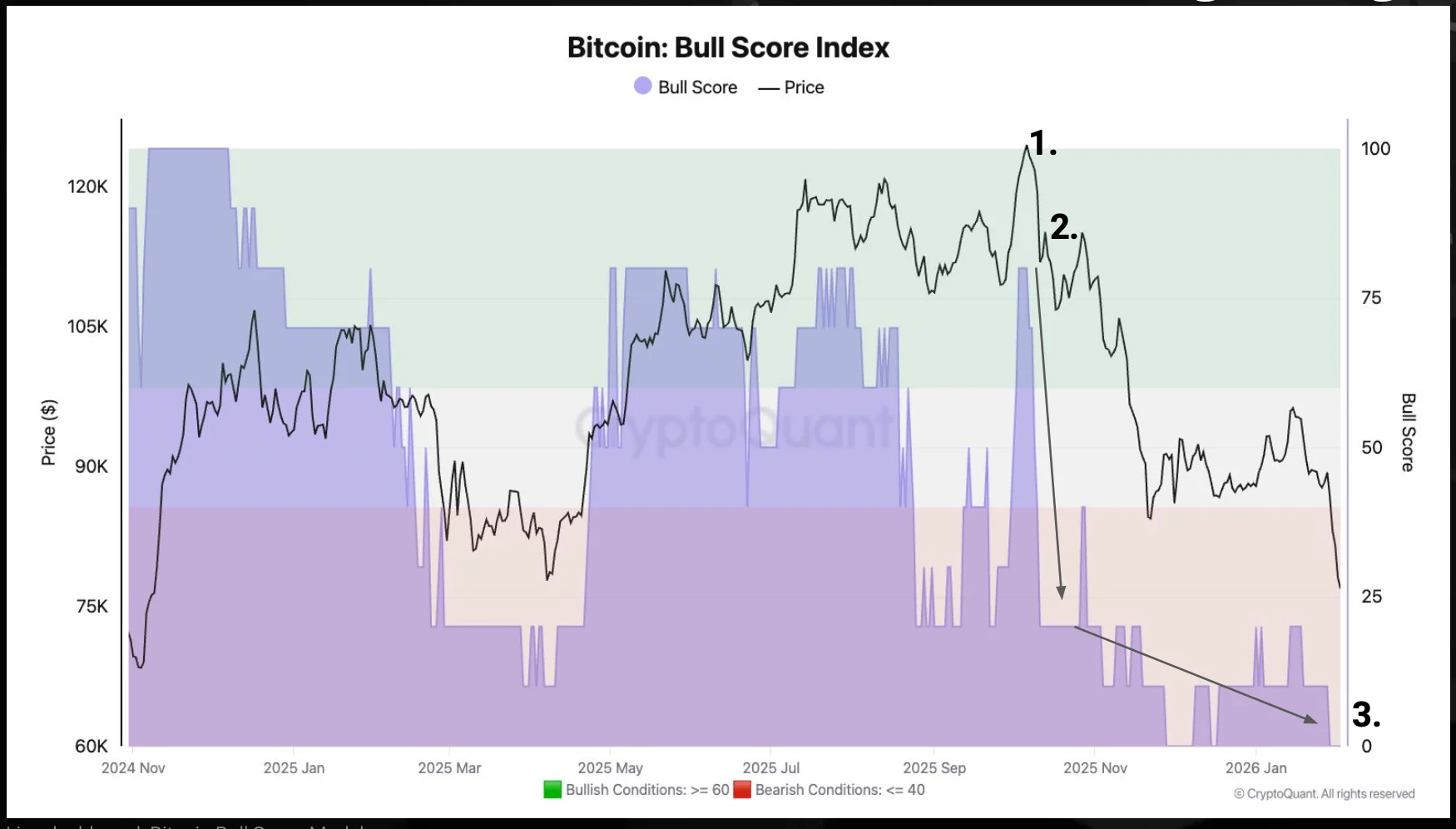
In recent weeks, Bitcoin has seen a significant decline, plunging toward a potential support level near $60,000. On-chain data from CryptoQuant indicates that the bearish sentiment in the market is deepening, raising concerns among investors. With Bitcoin peaking at nearly $126,000 in early October, the rapid downturn following the October 10 liquidation event has left many wary. As of now, the cryptocurrency is trading around $67,350, and analysts suggest that a drop to the $60,000 level could take several months, with key support zones in between.
CryptoQuant’s Bull Score Index has plummeted to zero—the most bearish reading possible—signifying a drastic shift from earlier optimism when the index was at 80 shortly after the Bitcoin peak. Analysts point out that the next major support area lies between $60,000 and $70,000, where both previous cycle highs and Bitcoin’s production costs fluctuate. This range appears critical for Bitcoin’s price recovery, with the previous all-time high set at $69,000, and production costs estimated at around $65,000 to $70,000.
Structural Weakness in the Crypto Market
The ongoing decline of Bitcoin reflects a broader "structural weakness" in the entire crypto market. A significant contributor to this weakness is the waning institutional demand. In 2025, U.S. spot Bitcoin exchange-traded funds (ETFs) were net buyers, acquiring over 46,000 BTC, but recent data reveal a stark reversal. By 2026, these ETFs have transitioned to net sellers, offloading roughly 10,600 BTC. The resulting demand gap—around 56,000 BTC—has intensified selling pressures, contributing to the cryptocurrency’s persistent drop.
Simultaneously, U.S. retail investor participation remains tepid. The Coinbase premium, a metric that gauges Bitcoin prices on Coinbase against global exchanges, has been negative since mid-October 2026. Historically, positive premiums have signaled strong demand and bullish market conditions, but this has shifted. CryptoQuant highlights the importance of U.S. demand in previous bull markets, which seems to be absent in the current environment.
Deteriorating Liquidity Conditions
The liquidity landscape within crypto markets is also tightening. According to CryptoQuant’s analysis, the market capitalization of Tether’s USDT stablecoin has seen a significant contraction of $133 million in the last 60 days, marking its first decline since October 2023. This contrasts sharply with the previous peak of $15.9 billion experienced in late October 2025. Typically, such liquidity contractions signal adverse market conditions often associated with bear market phases, further intensifying the prevailing bearish sentiment.
Moreover, longstanding demand growth for Bitcoin has sharply declined. An analysis shows that over the last four months, annual spot demand growth dwindled from 1.1 million BTC to a mere 77,000 BTC, representing a dramatic 93% reduction. This decline indicates that much of the demand growth from this cycle has already been absorbed, creating a bearish backdrop for Bitcoin prices moving forward.
Technical Indicators Favor Bearish Outlook
Technical indicators corroborate the bearish outlook for Bitcoin. The cryptocurrency has fallen below its 365-day moving average for the first time since March 2022. This decline marks a pivotal moment in confirming a downward trend. Since breaking this critical level on November 12, 2025, Bitcoin’s price has plunged by 23% within 83 days. To put this in perspective, the decline during the early stages of the previous bear market in January 2022 was only 6% after 83 days, indicating that the current downturn is more severe.
Market participants and analysts are closely scrutinizing these indicators to gauge when Bitcoin might stabilize. The breaching of critical moving averages, combined with significant declines in demand and liquidity, paints a somber picture for traders and investors alike.
Investor Sentiment and Market Outlook
As investor sentiment shifts towards caution, many in the crypto community remain concerned about the implications of a further drop in Bitcoin’s value. The current market conditions could prompt a reevaluation of investment strategies, as both retail and institutional investors weigh the risks of entering or remaining in the market. Experts emphasize the importance of closely monitoring key price levels and indicators in the coming weeks.
Given the local support levels between $60,000 and $70,000, market participants are speculating whether Bitcoin can maintain its posture above these critical thresholds. A sustained drop below $60,000 could trigger further bearish sentiment, potentially leading to increased selling pressure and a prolonged bear market.
Conclusion: Navigating Uncertain Waters
In conclusion, Bitcoin’s recent price decline reflects a deepening structural weakness in the crypto market, highlighted by declining institutional demand, subdued retail participation, and deteriorating liquidity conditions. The technical indicators indicate a pronounced bearish trend, raising concerns about potential further declines towards the $60,000 mark.
As the market navigates these uncertain waters, investors must remain vigilant and adaptable to the fluid conditions that characterize the cryptocurrency landscape. Understanding the interplay between demand, liquidity, and technical indicators will be crucial for making informed decisions in this challenging environment. As always, it is essential to exercise caution and conduct thorough research before making any investment commitments in the world of cryptocurrency.
Disclaimer: The content in this article is for informational purposes only and does not constitute financial advice. Trading and investing in cryptocurrencies involve risk, and individuals should conduct their research before making investment decisions.