



The Current State of Bitcoin: Are We Entering a Bear Market?
Bitcoin, the leading cryptocurrency, has been experiencing significant fluctuations in demand, prompting onchain analytics firm CryptoQuant to declare the onset of a bear market. According to their analysis, weakening demand has become a pivotal indicator of this market transition. They suggest that after three significant waves of demand in 2025—spurred by the U.S. spot ETF launch, the results of the presidential elections, and the rapid growth of Bitcoin treasury companies—demand has notably decreased since early October. This decline not only reduces the support for Bitcoin’s price but also raises concerns about its future prospects.
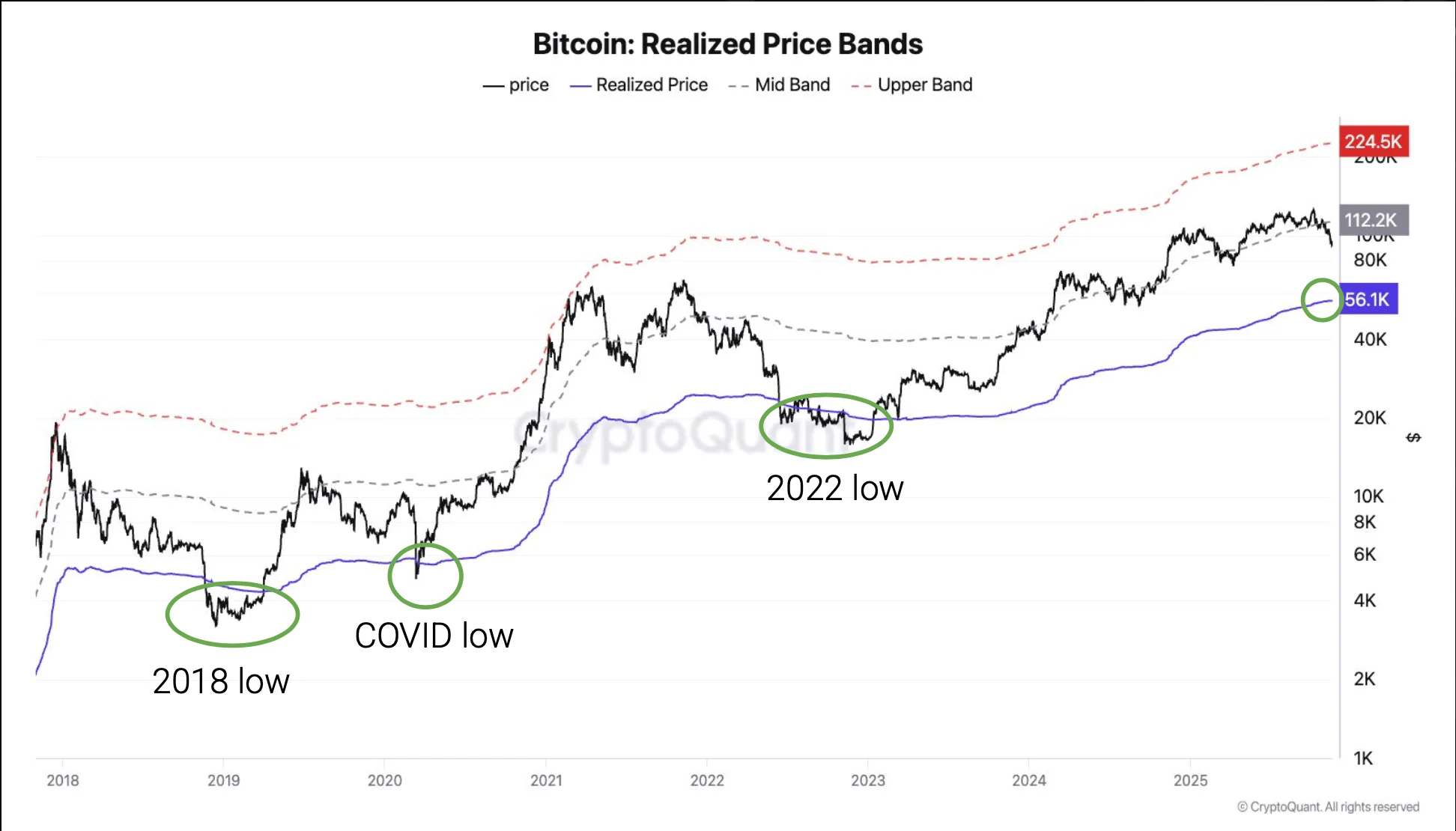
CryptoQuant’s report indicates potential downside risks for Bitcoin, forecasting a drop to $70,000 in the short term, with a more severe dive to $56,000 possible if momentum fails to recover. Historical patterns suggest that bear market bottoms for Bitcoin often align with its realized price, currently around $56,000, which would signify a 55% decrease from its all-time high—a relatively moderate retracement based on past bear markets. The intermediate support level appears to reside at $70,000, marking a critical threshold for investors.
Timing Predictions and Market Trends
In terms of timing, CryptoQuant’s head of research, Julio Moreno, anticipates that Bitcoin could reach the $70,000 mark within three to six months. Conversely, the $56,000 target may materialize in the latter half of 2026 if the market trajectory continues downward. Moreno pointed out that the bear market effectively commenced around Mid-November 2025, following the largest liquidation event in cryptocurrency history on October 10. The aftermath of this event has shown a continual decline in market demand, further solidifying CryptoQuant’s bearish outlook.
One notable statistic from CryptoQuant’s analysis is the performance of U.S. spot Bitcoin ETFs. In the fourth quarter of 2025, these ETFs turned into net sellers, reducing their holdings by approximately 24,000 BTC. This is a stark contrast to the previous year, where ETFs were net buyers, indicating a changing sentiment in institutional investment. Furthermore, the trend of addresses holding between 100 and 1,000 BTC—often reflective of institutional players—is also declining, echoing the patterns observed before the 2022 bear market.
Impact of Derivative Markets and Trading Indicators
The analysis of Bitcoin’s derivative markets adds another layer of insight into the current landscape. According to CryptoQuant, funding rates in perpetual futures markets are at their lowest since December 2023. This decline in funding rates typically signifies a diminishing appetite for long positions, a characteristic often associated with bear market conditions. Experts suggest that once Bitcoin slips below its 365-day moving average—a technical threshold historically indicative of market trend shifts—it signals a possible further decline.
CryptoQuant emphasizes that demand cycles, rather than halving events, govern Bitcoin’s four-year market cycles. The group’s findings suggest that periods of growth and contraction in demand are the primary drivers of Bitcoin’s volatility. As demand peaks and subsequently diminishes, the likelihood of entering a bear market increases, independent of external factors like supply constraints or previous price trends.
The Broader Outlook: Mixed Predictions from Analysts
While CryptoQuant presents a bearish forecast for Bitcoin, perspectives from other financial institutions exhibit greater optimism. Citigroup, for instance, projects a base-case scenario for Bitcoin at $143,000 within the next year, with an even more bullish case reaching $189,000. They also flag $70,000 as a crucial support level, while their bear case suggests a potential fallback to around $78,500.
Standard Chartered has adopted a more conservative stance, cutting its Bitcoin price target for 2026 in half to $150,000. They have also lowered expectations across various time frames, highlighting a cautious outlook amidst fluctuating market conditions. Conversely, JPMorgan retains a favorable outlook, estimating that Bitcoin could reach around $170,000 over the next six to twelve months based on its risk-adjusted volatility compared to gold. Meanwhile, Bitwise forecasts Bitcoin will achieve new all-time highs by 2026.
The Bottom Line: Navigating the Bitcoin Market
In summary, the cryptocurrency market is currently experiencing a complex and transitional phase. With CryptoQuant’s analysis suggesting a bear market fueled by decreasing demand, investors must remain vigilant. The contrasting outlooks from various financial institutions remind us of the inherent unpredictability of Bitcoin and the broader crypto ecosystem.
As the market continues to evolve, understanding the underlying factors driving Bitcoin’s price fluctuations—such as demand cycles, institutional investment trends, and macroeconomic influences—will be critical for stakeholders. Keeping an eye on key price levels and market sentiment will help investors navigate this volatile landscape effectively.
Conclusion: Expert Insights and Future Considerations
As Bitcoin continues to hover around the $87,800 mark, the upcoming months will be crucial in determining its trajectory. Further confirmation of declining demand, combined with external economic factors, could solidify the bearish narrative presented by CryptoQuant. However, the market remains influenced by various external forecasts that suggest potential rebounds and new highs.
Investors are encouraged to diversify their strategies and incorporate detailed analysis to make informed decisions in this ever-changing market environment. With both bullish and bearish assessments, it is evident that the landscape of cryptocurrency investment requires a nuanced understanding of market signals and predictive analytics. The future of Bitcoin remains uncertain, but its significance in the financial world is undeniable.
By remaining informed and adaptable, investors can better position themselves to navigate the challenges and opportunities presented by the cryptocurrency market, regardless of prevailing trends.