


The Rise of USDC: Analyzing Stablecoin Market Volumes and Trends
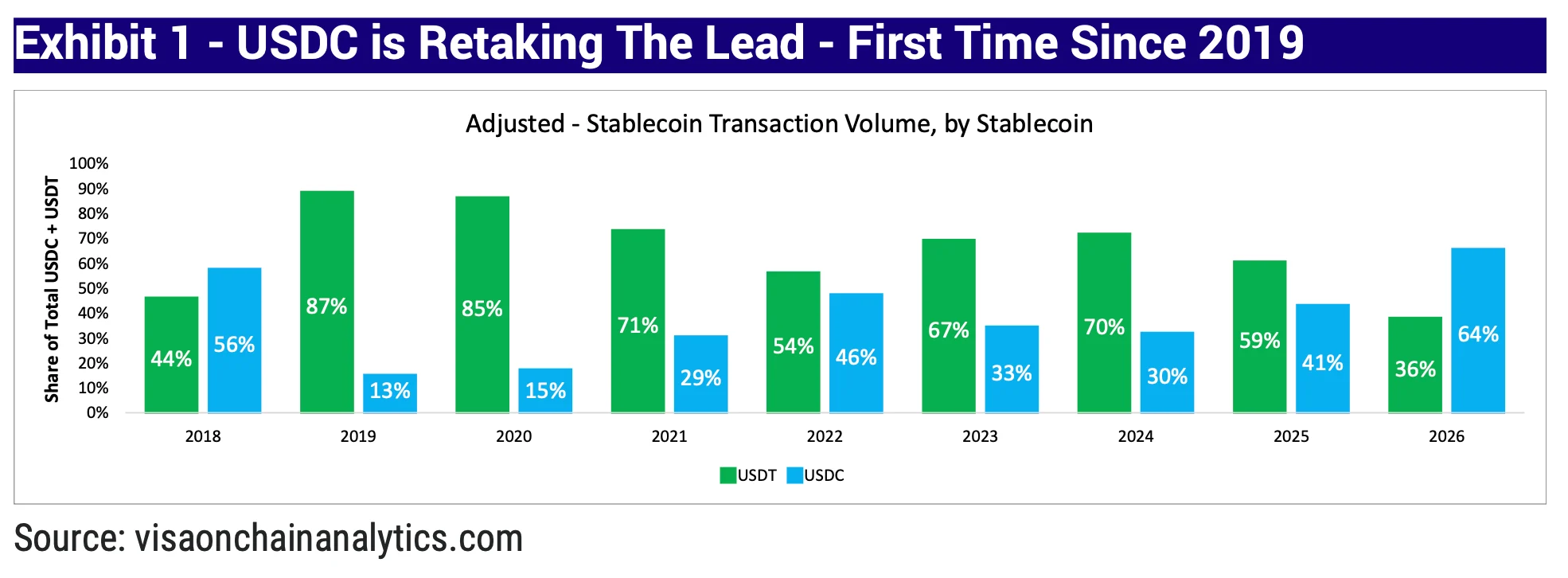
In a notable shift within the cryptocurrency landscape, recent analysis by Mizuho has indicated that the adjusted trading volume of Circle’s USDC stablecoin has outpaced Tether’s USDT for the year-to-date, marking an important transition in the stablecoin arena. This development points to a potential change in consumer habits and trust dynamics as USDC begins to capture a greater share of active trading among users.
Mizuho’s report revealed a stark contrast to long-standing trends between 2019 and 2025, during which USDT consistently dominated volume metrics. With current figures showing USDC and USDT volumes at a 64% market share for USDC, the analysis emphasizes a significant shift in market preferences. The classification of "adjusted volume" as used by Mizuho corresponds to transactions from recognized entities, whether in Centralized Exchanges (CEXs) or Decentralized Exchanges (DEXs), that exhibit activity indicative of real user engagement—specifically excluding transactions with minimal activity.
Furthermore, the Mizuho research outlines that this "adjusted volume" essentially captures transactions that reflect meaningful economic activities. Examples include businesses processing payments to suppliers or transactions across varied platforms like DeFi and DEX services. This focus on substantive engagement distinguishes USDC as a more viable option for day-to-day transactions compared to its competitors, thereby creating a foundation for USDC’s rising prominence in everyday economic activities.
Despite these volume advantages, it’s important to note that USDT continues to lead in total market capitalization, boasting an impressive $184 billion compared to USDC’s $79 billion. This reveals that while USDC is gaining traction in terms of transactional use, USDT still holds a significant edge in overall supply. Critics argue that market cap alone should not determine the long-term winner in the stablecoin race; rather, the emphasis should be on usage and application in everyday life.
Analysts express optimism regarding USDC’s potential trajectory within the sandbox of stablecoins, asserting that its practical applications in commerce may ultimately establish it as the preferred digital dollar for various users. This sentiment highlights a shift away from purely quantitative assessments of market cap, urging consideration of how a stablecoin integrates into real-world financial systems.
Ultimately, while USDT remains a major player in the stablecoin market, the recent findings from Mizuho underscore the ongoing evolution in user preferences towards USDC, particularly as it pertains to functional utility. The ongoing vitality of this space signifies a broader trend, emphasizing that successful digital currencies will be those adequately growing in user engagement within daily transactional frameworks, solidifying their relevance in the financial ecosystem.
In conclusion, as the landscape of digital currencies continues to evolve, users, investors, and analysts alike should keep a keen eye on these emerging trends in stablecoin usage. With USDC on the rise and showing increasing significance in daily economic activities, it could very well reshape the future of how digital payments are perceived and utilized in both traditional and modern frameworks.