




Bitcoin ETFs See Continued Growth Amid Market Fluctuations
In a promising development for the cryptocurrency market, spot Bitcoin exchange-traded funds (ETFs) have recorded their second consecutive day of net inflows, amassing an impressive $186.1 million on Wednesday, following a stronger influx of $411.5 million the previous session. This uptick indicates growing investor confidence in Bitcoin ETFs, a product that has gained significant traction since its launch in January 2024. The 13-fund group representing these ETFs has now successfully accumulated around $57.1 billion, contributing to a total net asset value of $97.6 billion as of April 15—a noteworthy figure that represents approximately 6.5% of Bitcoin’s overall market capitalization, according to data sourced from SoSoValue.
Among the 13 ETFs, only two managed to secure positive inflows on Wednesday, with BlackRock’s iShares Bitcoin Trust (IBIT) leading the pack. IBIT recorded an impressive $291.9 million, marking its largest single-day inflow since early April. Morgan Stanley’s Bitcoin ETF (MSBT) ranked second, attracting $19.3 million. The performance of these funds not only highlights the growing interest in Bitcoin but also positions them favorably against competing products in the market. Notably, Morgan Stanley’s MSBT achieved a remarkable milestone by surpassing its main competitor just after six trading days, gathering over $103 million in total net inflows, while WisdomTree’s Bitcoin Fund lagged at $86 million during the same period, as indicated by Farside data.
Despite the overall positive inflow trend, the ETF landscape was not without its challenges. Eight funds within the group did not experience any net flows, suggesting a degree of volatility within investor sentiment. Furthermore, Fidelity’s Bitcoin ETF (FBTC) reported significant outflows amounting to $47.4 million, while Ark Invest and 21Shares’ ARKB and Grayscale’s GBTC also faced redemptions of $42.2 million and $23.4 million, respectively. Smaller outflows were recorded for Bitwise’s BITB and VanEck’s HODL, with reductions of $8.5 million and $3.7 million. This mixed performance underscores the competitive nature of the Bitcoin ETF market, as certain products attract investor interest while others struggle to maintain their appeal.
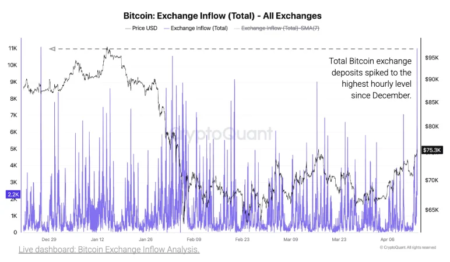
In the midst of these ETF developments, the price of Bitcoin has shown considerable volatility, trading above $74,600 as of Thursday. This represents a 3% increase over the past week and a significant recovery of 23% since it dipped near $60,000 on February 6. However, it’s essential to note that despite these gains, Bitcoin’s current price remains approximately 41% lower than its all-time high of around $126,000, achieved on October 6, 2025. Such fluctuations reflect the broader uncertainties that continue to influence the cryptocurrency market, where investor sentiment can shift rapidly based on global trends, news, and regulatory actions.
The growth experienced by Bitcoin ETFs reflects a broader trend of institutional adoption and acceptance of cryptocurrencies as viable investment vehicles. As notable financial institutions launch these funds, they provide more traditional investors with easier access to Bitcoin, thus paving the way for increased market participation. The surge in interest is also evidenced by the growing number of institutional investors exploring digital assets within their portfolios. With established players like BlackRock and Morgan Stanley entering the fray, the credibility and stability of Bitcoin ETFs are likely to enhance their attractiveness for both individual and institutional investors alike.
It remains to be seen how these trends will evolve in the coming months, especially in light of ongoing market dynamics and potential regulatory changes. As the cryptocurrency sector continues to mature, factors such as market liquidity, technological advancements, and legislative frameworks will influence the competitiveness of Bitcoin ETFs in the investment landscape. In the interim, the current momentum indicates that Bitcoin ETFs are becoming a significant part of the broader financial ecosystem, capturing the interest and investment of an increasingly diverse array of market participants.
In summary, while Bitcoin spot ETFs have shown robust growth recently, with an influx of funds signaling investor confidence, the landscape remains diverse and competitive. Noteworthy funds like BlackRock’s IBIT and Morgan Stanley’s MSBT are taking center stage, demonstrating the potential for growth and market capture in the sector. However, ongoing outflows from other products and fluctuations in Bitcoin’s price underline the complexities of cryptocurrency investments. Investors looking to navigate this evolving market should remain informed and cautious, considering both the opportunities and challenges presented by the dynamic nature of Bitcoin ETFs.