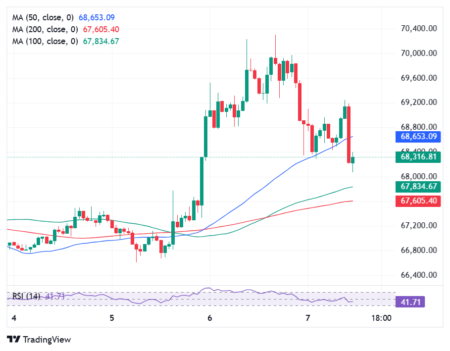





Bitcoin Price Stalls Below $70,000: An In-Depth Analysis
Bitcoin, the leading cryptocurrency, has recently faced significant resistance as it stalled below the critical $70,000 mark. According to data from on-chain analytics firms like Glassnode, recent attempts to break above this level have been met with profit-taking and liquidity issues. The ongoing struggle illustrates the complexities of market dynamics in an ever-evolving cryptocurrency landscape, particularly as investors recalibrate their strategies amid economic uncertainties.
Current Trading Dynamics
Fresh data indicates that Bitcoin has encountered persistent selling pressure every time it approaches the $70,000 barrier, suggesting that traders are actively taking profits. Glassnode’s analyses indicate that each recovery attempt since early February has resulted in a demand exhaustion at approximately $70K. The situation is compounded by thin liquidity, making the price movement volatile. For instance, on February 25, Bitcoin peaked at $69,400 before succumbing again to selling pressure. This pattern reveals that while there is robust investor interest, market conditions are not conducive to sustained upward movement.
The Impact of Liquidity Constraints
The current liquidity situation appears to be a substantial hurdle for Bitcoin’s price progression. Glassnode highlights that even a net realized profit exceeding $5 million per hour has not been enough to overcome resistance around $70,000. This is a sharp contrast to Q3 of 2025, where profit realizations were significantly higher, ranging from $200 million to $350 million per hour. Moreover, there has been a concerning decline in Tether (USDT) reserves on exchanges, which dropped from $60 billion to approximately $51.1 billion within two months. CryptoQuant warns that if USDT reserves fall below $50 billion, it could trigger further selling across major cryptocurrencies, including Bitcoin.
Slowing On-Chain Participation
In addition to liquidity challenges, on-chain participation signals a decline in investor activity. Recent figures reveal a drop in active addresses from 376,000 to 263,000, indicative of reduced engagement from both retail and institutional investors. CryptoQuant’s findings further support this observation, confirming a decrease in unique senders and receivers in the network. A slowdown in participation could have downstream effects on Bitcoin’s price as both retail and institutional actors may be less likely to stimulate demand in the current environment.
Defensive Yet Stable Market Structure
While challenges abound, some analysts maintain a cautiously optimistic outlook regarding Bitcoin’s current market structure. Nexo describes the prevailing conditions as compressed but orderly, with Bitcoin trading below its intrinsic market value of approximately $79,000 but situated above its realized price near $54,900. The firm highlights a demand cluster between $60,000 and $69,000 that continues to absorb market pressure, suggesting a foundation for potential future growth. Despite the present liquidity constraints, the market appears stable enough to withstand external pressures, at least for now.
Macro Conditions and ETF Dynamics
Broader macroeconomic conditions significantly influence Bitcoin’s liquidity and prospects. The January Federal Open Market Committee (FOMC) minutes indicated that the Federal Reserve is not inclined to cut interest rates imminently, and this may limit liquidity expansion in the near term. Additionally, ETF flows have moderated considerably, with five weeks of net outflows resulting in a substantial $3.8 billion drop since late January. Although cumulative inflows remain robust, the inconsistency of institutional demand may hinder Bitcoin’s ability to break past resistance levels and establish higher price points.
Conclusion: Future Price Outlook and Analyst Sentiment
As of the latest reports, Bitcoin is trading at approximately $67,021, marking a 2.4% decline over the past 24 hours and a notable 23.83% drop over the last month. Initially dipping from $68,000 to around $63,000, Bitcoin’s recent movements suggest it is now stabilizing near the $67,000 mark, with solid support emerging around $65,000. Resistance still looms between $68,500 and $69,500. Analyst Ted notes that recent gains appear predominantly driven by spot demand, but the absence of a significant return of U.S. buyers is a concern. He remains optimistic in the short term but advises caution if perpetual-driven activities continue to dominate the market.
In summary, while Bitcoin currently sits beneath the psychologically significant $70,000 level amid liquidity constraints and waning on-chain activity, the market’s defensive structure hints at potential resilience against further downside. As investors remain attentive to both macro conditions and market indicators, Bitcoin’s trajectory may hinge upon the interplay between profit-taking, liquidity, and broader economic factors.