




Bitcoin’s Recent Market Decline: Analysis and Future Projections
Bitcoin, the pioneering cryptocurrency, has experienced a notable decline, mirroring trends seen in the broader crypto market. Current financial uncertainties, particularly those surrounding potential increases in U.S. tariffs, have dampened investor sentiment. This situation has resulted in a significant pullback for cryptocurrencies as they follow equities downward. Furthermore, JPMorgan’s CEO, Jamie Dimon, indicated that artificial intelligence is reshaping landscapes in ways that could disrupt various markets, further affecting investor confidence in volatile assets like Bitcoin. Analysts note that Bitcoin’s performance is increasingly linked to overall market sentiment rather than its intrinsic fundamentals, amplifying the risks associated with potential further declines.
Bitcoin’s Support Breakdown and Market Indicators
Recent data from CryptoQuant reveals a significant shift in Bitcoin’s market dynamics. The Coinbase Premium Index has signaled a weakness, leading to Bitcoin’s price falling below critical support levels. After a transient uptick in its 30-minute simple moving average, Bitcoin failed to maintain its momentum, signaling a potential downward trend. This inability to sustain upward movement has led to declining buying pressure, with sellers overpowering buyers, thus intensifying the bearish sentiment surrounding Bitcoin. The breakdown has raised alarms; with analysts like Ted indicating that falling below the $65,000 support level exposes Bitcoin to lower liquidity positions, indicating a fear-driven market where lower buying interest prevails.
Repercussions of the Current Economic Climate
The intricacies of the current economic environment are exacerbated by comments from JPMorgan’s CEO regarding lending practices and market stability. Dimon’s perspective echoes concerns reminiscent of pre-2008 financial conditions, highlighting excessive lending risks taken by competitors aiming for short-term profits. While he reassures stakeholders that JPMorgan will not succumb to such reckless behavior, the looming uncertainty regarding the credit cycle poses risks that could further destabilize financial markets, impacting cryptocurrencies like Bitcoin. As fears of economic retraction gain traction, riskier assets face increasing downward pressure, mirroring broader market transactions.
Bitcoin Price Movements: A Closer Look
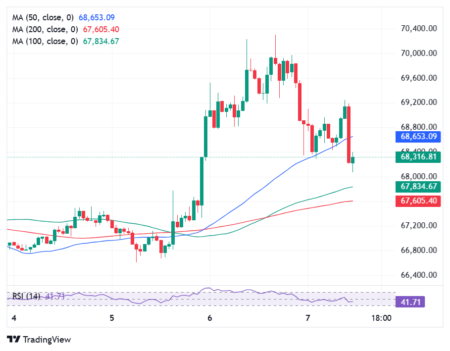
The Bitcoin price currently stands at approximately $64,438, reflecting a slight decline of 0.30% over the last 24 hours and a weekly downturn of about 5.33%. Price volatility has defined recent trading sessions, with Bitcoin reaching a high near $68,500 before sharp retractions began. A notable selloff on February 23 drove the price down, and while there was a brief recovery to $66,500, a series of lower highs has set a bearish tone for Bitcoin’s future. With immediate resistance observed at $64,500 to $65,000 and a critical support level near $62,500, the prevailing trend indicates a clearly defined downtrend in the short term.
Long-Term Projections Amidst Short-Term Volatility
Despite these immediate pressures, forecasts from TD Cowen present a more optimistic long-term outlook for Bitcoin. They propose a potentially transformative scenario where the tokenized asset landscape grows exponentially while the velocity of Bitcoin transactions diminishes. Under such conditions, they speculate that Bitcoin’s value could surge, possibly reaching $450,000 per coin over time. Additionally, TD Cowen predicts Bitcoin may settle around $225,000 by the conclusion of fiscal 2027, contingent on several assumptions—primarily the increased tokenization of real-world assets. These projections, while ambitious, reflect a belief in Bitcoin’s potential to recover and thrive even in tumultuous market conditions.
The Role of Market Sentiment in Bitcoin’s Future
At this juncture, it’s vital to recognize that Bitcoin’s trajectory seems to be increasingly influenced by market sentiment rather than its own underlying economic indicators. The relationship between Bitcoin prices and broader market movements signifies a transformative period where external factors are dictating performance. As such, investors are urged to consider these market influences alongside historical trends. Currently, key indicators reflect a market dominated by sellers and risk-averse behavior. As circumstances unfold, the interplay between evolving economic conditions, investor sentiment, and technological innovations will shape the future of Bitcoin, guiding its path through potential recovery or further decline.
In summary, the current decline in Bitcoin illustrates a complex interplay of market forces, investor psychology, and external economic indicators. As the cryptocurrency industry continues to adapt to evolving conditions, both short-term fluctuations and long-term projections need to be assessed carefully. Investors should remain informed and cautious, as the risks and rewards associated with Bitcoin and the cryptocurrency market remain particularly dynamic.